After sending new photos to the state pond expert and getting a suggestion to take the pH of the pond, I purchased testing strips from Lowes.
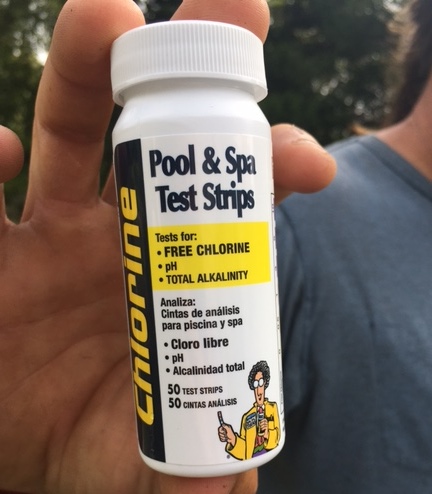
I purchased test strips at Lowes in the pool maintenance section.
At my next trip to the shore house I tested the water when we got there in the early morning.

At 9:30 a.m. the pH results correspond to 6.8.
The pH result was 6.8. Total alkalinity was 0 (zero). And, naturally, there was no chlorine.

At 6:30 p.m. the same day the pH was the same as in the morning — 6.8.
I left test strips with my son who, like me, had been a lifeguard and knew how to test water for pH. He tested again in the late afternoon.

Actually the pond is maintaining itself very well.
A bit of advice we received before the pH test was that the water settling test showed that the color is not clay turbidity, rather, other dissolved organics and some phytoplankton. A brownish color that does not settle can also be an indication of tannins from decaying plant matter. Tannins are not harmful to aquatic life, but can reduce the pH of the water. The best approach is to reduce the amount of organic matter entering the pond.
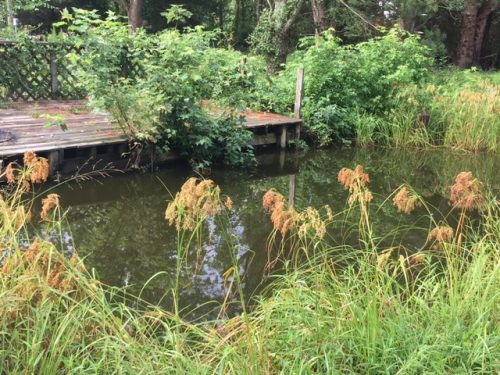
Plants are good but maple trees (near the dock) will need to be removed.
I sent the results of the pH test to our expert at the Maryland Extension Agency who said, “A pH of 6.8 is good. The fact that they [the 2 readings] are similar suggests that the water is well buffered (good alkalinity or amount of carbonate bases) and that the phytoplankton population is light. All good news.”

In spring we’ll move bearded iris (light foreground leaves) from The Glade to the shore house pond.
Jo
 Let's Fake the Music